y-cli

MCP.Pizza Chef: luohy15

y-cli is a compact command-line interface chat application designed to facilitate AI conversations directly in your terminal. It supports flexible storage options including local JSONL files and Cloudflare KV/R2 for cloud backup. y-cli enables interactive chat with tool execution visualization and supports multiple bot configurations using various API formats like OpenAI and Dify. It also integrates reasoning models and fully supports the Model Context Protocol (MCP) for seamless AI model orchestration and interaction.

Use This MCP client To

Chat with AI models directly from the terminal Store and sync chat history locally or in the cloud Visualize tool execution during AI conversations Configure multiple AI bots with different APIs and models Integrate reasoning models for advanced AI responses Use MCP to manage AI context and tool interactions

README

y-agent

A personal AI agent system built on top of coding agents.

Renamed from y-cli. y-cli wrapped model APIs; y-agent wraps coding agents.
Demo

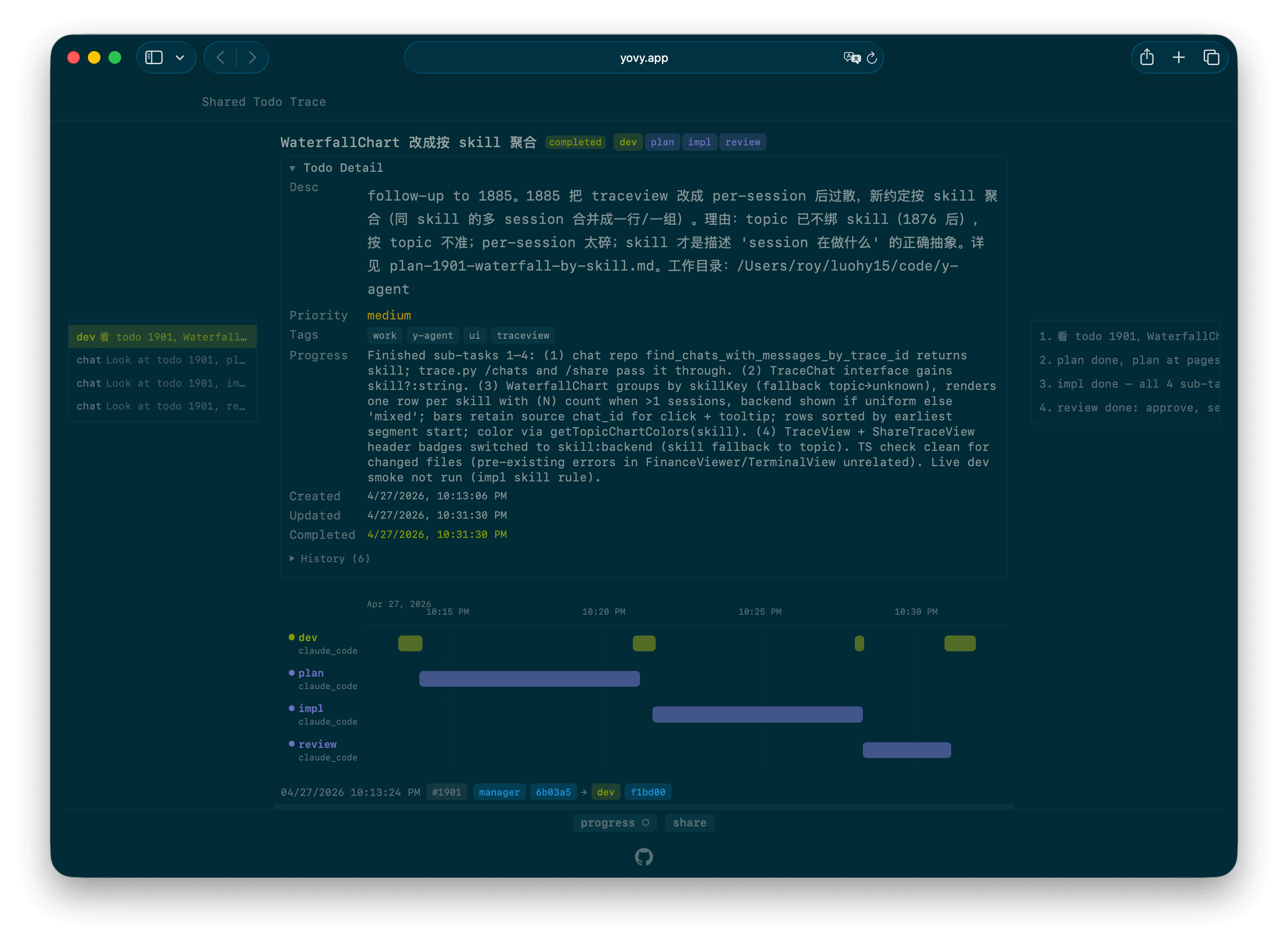
y-agent TraceView

A real trace: https://yovy.app/t/6fc5c4

Web chat renders inline artifacts from assistant messages: Mermaid diagrams, Vega-Lite charts, and sanitized artifact-svg blocks.


Coding agents like Claude Code / Codex are great for code, but code is only part of my daily life. I also have ledgers, calendars, todos, notes, emails. I want the agent to handle those too.

Three things came up while extending a coding agent into a personal agent system:

  1. How to give the agent context
  2. How to keep the agent always-on
  3. How to orchestrate multiple agents

Context

Same data for me and for the agent. Files go through read / write / edit. Anything I'd reach for a GUI to do, the agent reaches for a CLI — it's already happy in Bash. Rule: whatever I can do in the GUI, the agent can do via CLI. The underlying file or DB row is the same.

Always-on

I don't want to carry a laptop or open a terminal to use it. Coding agents run on a remote VM (EC2) inside tmux; a tail process parses their output into the database, so the web UI can chat with them directly. A Telegram bot covers mobile input. EC2 auto-hibernates when idle, so cost is near zero when nothing is running.

Orchestration

One session usually can't handle the whole thing — requests have to be routed to the right session. Claude Code ships sub-agents, but I wanted that layer outside, so sub-agent chats stay in my own DB and I can steer them mid-run.

y-cli FAQ

How does y-cli handle chat history storage?
y-cli supports flexible storage with local JSONL files and cloud options like Cloudflare KV and R2 for backup and sync.
Can y-cli support multiple AI models or bots?
Yes, it supports multiple bot configurations with any base_url, api_key, and model combination, including OpenAI and Dify formats.
What API formats does y-cli support for AI interactions?
It supports OpenAI chat completion streaming format and Dify chat-messages streaming format for flexible AI integration.
How does y-cli visualize tool execution?
y-cli provides an interactive chat interface that shows tool execution steps during AI conversations for better transparency.
Does y-cli support reasoning models?
Yes, it supports reasoning models like Deepseek-r1 and OpenAI o3-mini for enhanced AI reasoning capabilities.
What is MCP support in y-cli?
y-cli fully supports the Model Context Protocol, enabling structured, real-time context feeding and tool orchestration with AI models.
Is y-cli suitable for cloud and local environments?
Yes, it offers both local file storage and cloud storage options, making it versatile for different deployment scenarios.
Can y-cli be extended or integrated with other MCP tools?
Yes, as an MCP client, y-cli can orchestrate context and tools from various MCP servers and resources seamlessly.