
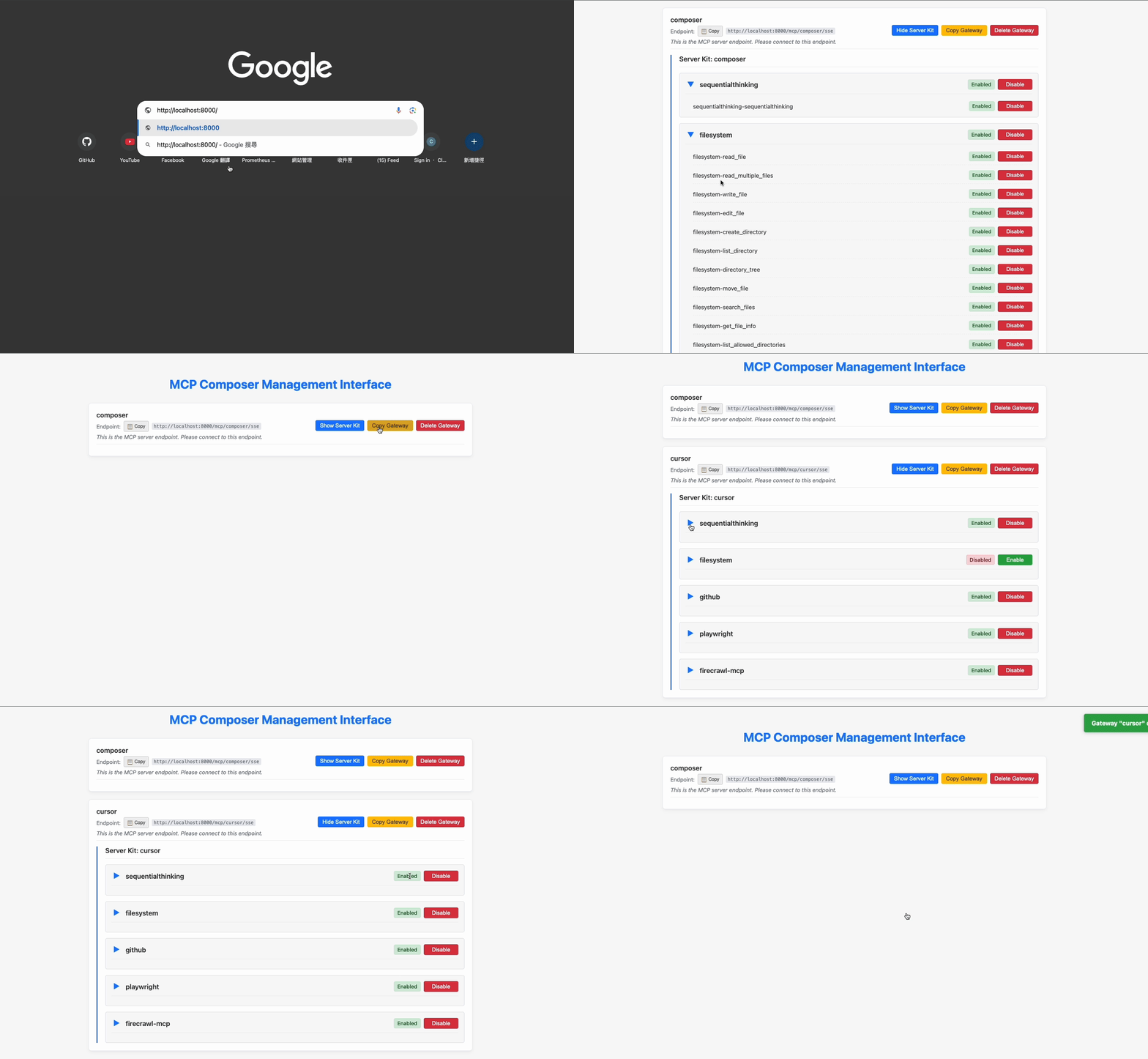
MCP Composer is a gateway service that centrally manages all your MCP servers. You can use it to consolidate all the MCP servers you need and open independent ports with different combinations of servers and tools for each service (like AI agents or tools) that requires access to MCP servers.
- Dynamic MCP Server Management: Dynamically manages connections to multiple MCP servers and their tools, enabling on-the-fly activation or deactivation of services.
- Unified SSE Interface: Exposes a single Server-Sent Events (SSE) interface that provides access to all capabilities of the managed MCP servers.
- Multiple Dynamic Endpoints: Supports dynamic creation and removal of multiple SSE endpoints to accommodate different AI agents or AI tools.
- Independent Interface Configuration: Each SSE interface independently manages its own combination of MCP servers and tools, allowing for customized service provision.
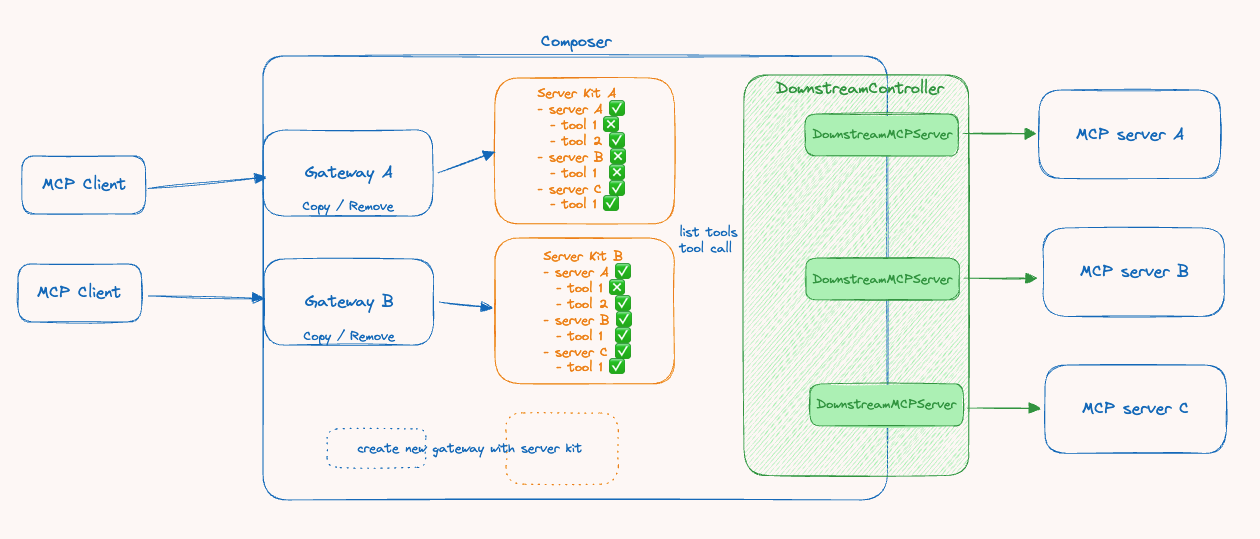
- MCP Client: External tools or AI agents and AI workflows, such as Cursor, n8n, etc.
- Gateway[A/B]: MCP server implementation bound to ServerKit and managed by the Composer, used to handle MCP Client connections.
- Server Kit: Manages and controls information about Downstream MCP servers and which tools within servers should be enabled.
- Downstream Controller: Responsible for controlling and managing connections to Downstream MCP servers.
- Downstream MCP Server: An internal object connecting to a Downstream MCP server, implemented as an internal MCP client that links to the Downstream MCP server.
- MCP Server: External MCP server services, such as: https://github.com/modelcontextprotocol/servers etc.
- Composer: Provides APIs to control and orchestrate Gateways, Server Kits, and Downstream Controllers.
- Python >= 3.12
- uv: A fast Python package installer and manager.
-
Clone the repository:
git clone https://github.com/htkuan/mcp-composer cd mcp-composer -
Install dependencies: Use
uvto sync the project dependencies.make install # or directly use uv # uv sync
use docker compose to run the project
make run-dockerBefore running the application, you need to configure the target MCP servers.
-
Copy the example configuration file:
cp mcp_servers.example.json mcp_servers.json
-
Edit
mcp_servers.jsonand enter the details of the MCP servers you want to connect to. -
Set up environment variables:
cp .env.example .env
-
Edit the
.envfile to configure the following settings:HOST: Server host address (default: 0.0.0.0)PORT: Server port (default: 8000)MCP_COMPOSER_PROXY_URL: MCP Composer proxy URL (default: http://localhost:8000)MCP_SERVERS_CONFIG_PATH: Path to the MCP servers configuration file (default: ./mcp_servers.json)
Use uv to run the FastAPI application:
make run
# or directly use uv
# uv run src/main.py
After the service starts, you can interact with the API through the API documentation in your browser (typically at http://127.0.0.1:8000/docs).
The project includes a Makefile to simplify common development tasks:
- Install dependencies:
make install - Format and check code:
make format(using Ruff) - Run the application:
make run
Contributions to this project are welcome! Please follow the standard GitHub Fork & Pull Request workflow. It's recommended to create an Issue for discussion before submitting a Pull Request.