
oryxos

oryxos

MCP.Pizza Chef: oryx-labs

OryxOS runs on your own servers and lets you define an agent by writing a plain-language description in a folder, with no code involved. Each one gets memory, two dozen built-in abilities, scheduled runs, notifications, and the ability to reach MCP tools you already use. Every action is written to an audit trail, and none of your data leaves your infrastructure. Getting it running takes Java, a build step, and a model provider key of your own, so budget real setup time.

Coding
Other

Use This MCP client To

Describe an agent in one sentence and watch it go live Run my own agents without sending data to a vendor Connect existing MCP tools to an agent I define Schedule an agent to run a task every morning Review a full record of everything an agent did Give an agent memory that survives between runs

README

OryxOS

Say it in plain language. A team of agents delivers.
The self-hosted Agent Operating System for the enterprise.

version MCP native Apache 2.0


OryxOS is the self-hosted Agent OS for the enterprise. Describe a task in one sentence of natural language — OryxOS breaks it down, assembles a team of agents, and they collaborate to deliver the result:
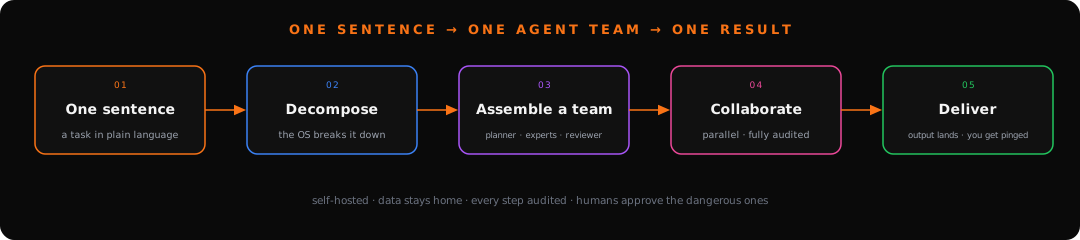
one sentence → decompose → assemble an agent team → collaborate → deliver the result

So every company can run its own agents — in plain language. No code to define an agent, no data leaving your infrastructure, every step audited.

  • Today, shipped: define an agent in one sentence (or one markdown directory) and it goes live instantly — with memory, 24 built-in tools, MCP connectors, skills, notifications, and cron scheduling, all on your own servers.
  • The north star: publish a task in one sentence and an agent team self-organizes to deliver it — planner, specialists, reviewer — fully audited, with humans approving the dangerous steps. See the roadmap.

Long-term vision: enter the Apache Software Foundation as a top-level project.

The Agent formula

Everything an agent needs is built into the OS — an agent just references what it wants:
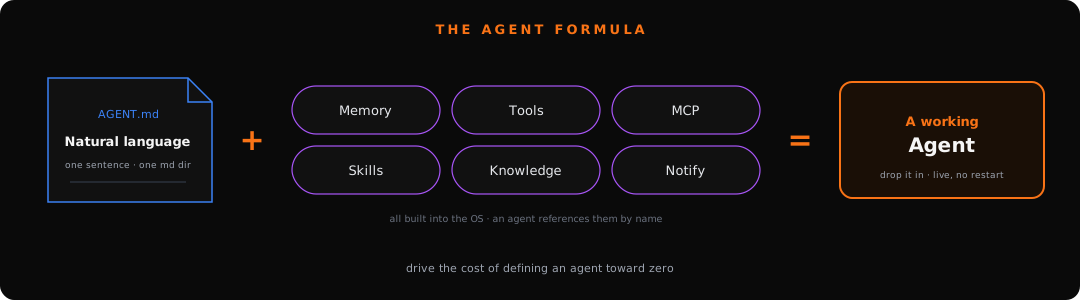
natural language (md) + Memory + Tools + MCP + Skills + Knowledge + Notify = a working Agent

This is the whole point: drive the cost of defining an agent toward zero. You write intent; the OS supplies the capabilities, the safety rails, and the audit trail.

What is an agent harness (and why an OS)

An agent harness is the scaffolding around a model that turns it into a working agent: the loop that drives reason → act → observe, the tools it can call and the execution that runs them, the context assembled before every call, the memory it accumulates, the sandbox that contains it, and the audit trail that records what it did. A bare model only generates text — the harness is what lets it do things, reliably and safely.

The bottleneck for reliable agents in production is not the model — it's the harness around it. And an enterprise never runs just one agent. OryxOS gives every agent the same production-grade harness, and runs the whole fleet like an operating system runs processes — that's the Agent Harness OS.

Model → Harness → OS

oryxos FAQ

Do I have to write code to make an agent?
No. An agent is a folder with a written description in it, and you can draft that description from a single sentence.
Where does my data go?
Nowhere outside your walls. It runs on your own servers, virtual machines, or Kubernetes, and it is built so nothing leaves your environment.
Can I use this to run a task on a schedule?
Yes — timed runs and notifications are built in, so an agent can wake up on a timetable and report back.
Do I need a paid model key?
Yes, you bring your own. DeepSeek, Qwen, OpenAI, and a local model through Ollama all work.
How hard is setup?
This one is for technical teams. You need Java 21 and Maven, then you build the project and start the server yourself.
Does it work with MCP tools I already have?
Yes. Agents reach outside tools over MCP, alongside built-in file, shell, and web abilities, all inside a sandbox with allowed-list checks.