gcp-mcp

MCP.Pizza Chef: eniayomi

Nine tools let your assistant list the Google Cloud projects you can reach, pick one to work in, pull recent log entries, and show your Kubernetes clusters and Cloud SQL databases. Billing coverage is thinner than it sounds: the tool named cost forecast returns your billing account details and no spending figures whatsoever. Anything past those listings runs as code the assistant writes on the spot under your own Google login, so it can change and delete real resources. There is no key to sign up for.

Unmaintained ยท no code changes since May 2025
Coding
Data

Use This MCP server To

See every Google Cloud project my account can reach Read the last few log entries from a service List my Kubernetes clusters in a chosen region Check whether billing is switched on for a project See which Cloud SQL databases are running and where Look up my spending budgets and their alert thresholds

README

GCP MCP

A Model Context Protocol (MCP) server that enables AI assistants like Claude to interact with your Google Cloud Platform environment. This allows for natural language querying and management of your GCP resources during conversations.
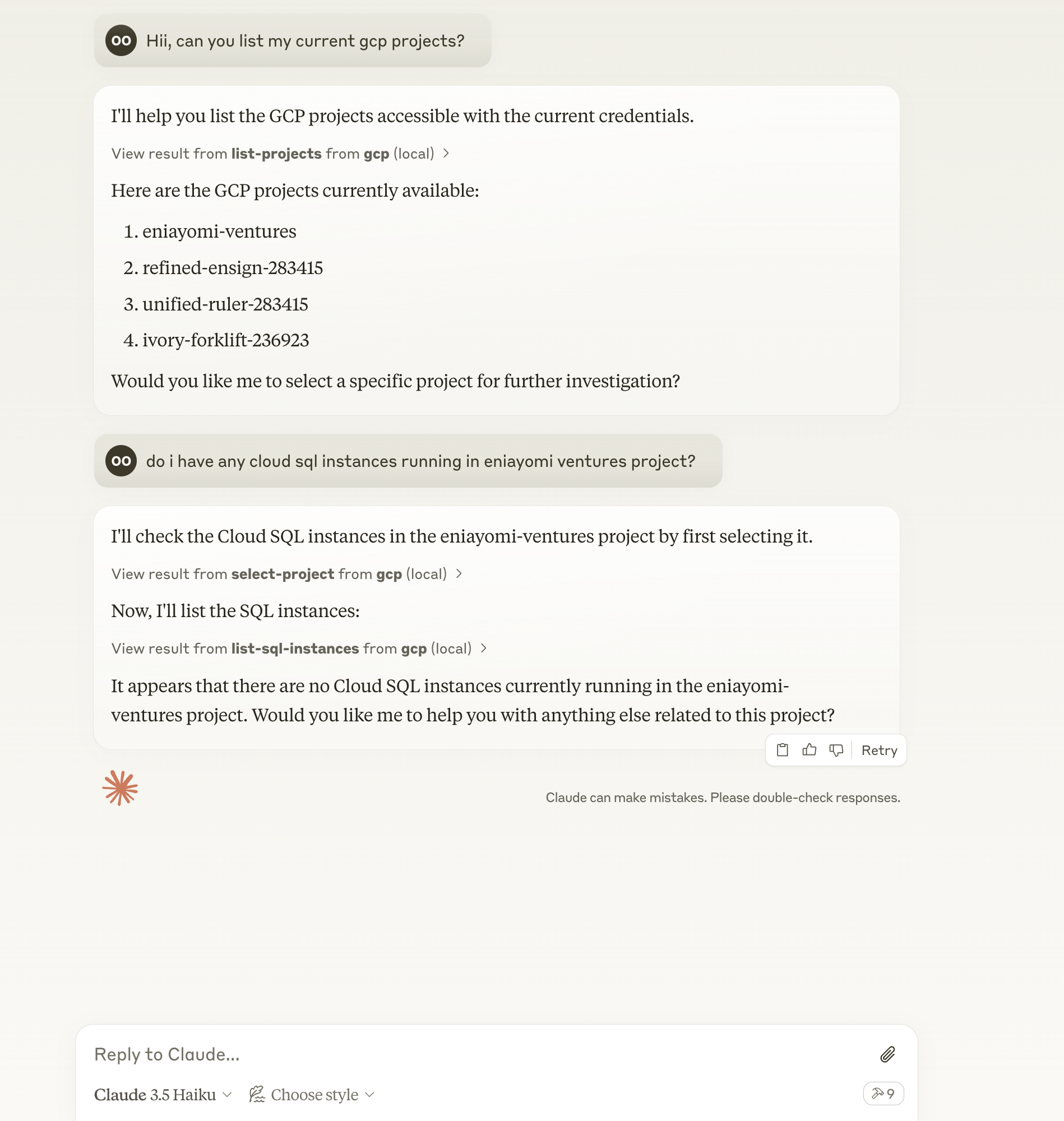
GCP MCP Demo

Features

  • ๐Ÿ” Query and modify GCP resources using natural language
  • โ˜๏ธ Support for multiple GCP projects
  • ๐ŸŒ Multi-region support
  • ๐Ÿ” Secure credential handling (no credentials are exposed to external services)
  • ๐Ÿƒโ€โ™‚๏ธ Local execution with your GCP credentials
  • ๐Ÿ”„ Automatic retries for improved reliability

Prerequisites

  • Node.js
  • Claude Desktop/Cursor/Windsurf
  • GCP credentials configured locally (application default credentials)

Installation

  1. Clone the repository:
git clone https://github.com/eniayomi/gcp-mcp
cd gcp-mcp
  1. Install dependencies:
npm install

Configuration

Claude Desktop

  1. Open Claude desktop app and go to Settings -> Developer -> Edit Config

  2. Add the following entry to your claude_desktop_config.json:

via npm:

{
  "mcpServers": {
    "gcp": {
      "command": "sh",
      "args": ["-c", "npx -y gcp-mcp"]
    }
  }
}

If you installed from source:

{
  "mcpServers": {
    "gcp": {
      "command": "npm",
      "args": [
        "--silent",
        "--prefix",
        "/path/to/gcp-mcp",
        "start"
      ]
    }
  }
}

Replace /path/to/gcp-mcp with the actual path to your project directory if using source installation.

Cursor

  1. Open Cursor and go to Settings (โŒ˜,)
  2. Navigate to AI -> Model Context Protocol
  3. Add a new MCP configuration:
{
  "gcp": {
    "command": "npx -y gcp-mcp"
  }
}

Windsurf

  1. Open ~/.windsurf/config.json (create if it doesn't exist)
  2. Add the MCP configuration:
{
  "mcpServers": {
    "gcp": {
      "command": "npx -y gcp-mcp"
    }
  }
}

GCP Setup

  1. Set up GCP credentials:

    • Set up application default credentials using gcloud auth application-default login
  2. Refresh your AI assistant (Claude Desktop/Cursor/Windsurf)

Usage

Start by selecting a project or asking questions like:

  • "List all GCP projects I have access to"
  • "Show me all Cloud SQL instances in project X"
  • "What's my current billing status?"
  • "Show me the logs from my Cloud Run services"
  • "List all GKE clusters in us-central1"
  • "Show me all Cloud Storage buckets in project X"
  • "What Cloud Functions are deployed in us-central1?"
  • "List all Cloud Run services"
  • "Show me BigQuery datasets and tables"

Available Tools

  1. run-gcp-code: Execute GCP API calls using TypeScript code
  2. list-projects: List all accessible GCP projects
  3. select-project: Select a GCP project for subsequent operations
  4. get-billing-info: Get billing information for the current project
  5. get-cost-forecast: Get cost forecast for the current project
  6. get-billing-budget: Get billing budgets for the current project
  7. list-gke-clusters: List all GKE clusters in the current project
  8. list-sql-instances: List all Cloud SQL instances in the current project
  9. get-logs: Get Cloud Logging entries for the current project

Example Interactions

  1. List available projects:
List all GCP projects I have access to
  1. Select a project:
Use project my-project-id
  1. Check billing status:
What's my current billing status?
  1. View logs:
Show me the last 10 log entries from my project

Supported Services

  • Google Compute Engine
  • Cloud Storage
  • Cloud Functions
  • Cloud Run
  • BigQuery
  • Cloud SQL
  • Google Kubernetes Engine (GKE)
  • Cloud Logging
  • Cloud Billing
  • Resource Manager
  • More coming soon...

Troubleshooting

To see logs:

tail -n 50 -f ~/Library/Logs/Claude/mcp-server-gcp.log

Common issues:

  1. Authentication errors: Ensure you've run gcloud auth application-default login
  2. Permission errors: Check IAM roles for your account
  3. API errors: Verify that required APIs are enabled in your project

Contributing

Contributions are welcome! Please feel free to submit a Pull Request.

License

MIT

gcp-mcp FAQ

Can I use this to find out what my Google Cloud bill will be?
Only partly. It shows whether billing is on, which account pays, and any budgets you set. The tool named cost forecast returns no spending figures at all, despite the name.
Do I need to sign up for a key?
No. It uses the Google Cloud login already on your computer, created by running the gcloud sign-in command once. Nothing goes to a third party.
Can it change or delete things in my cloud account?
Yes. Beyond the nine named tools it runs code written on the fly with your full account permissions, which can create, alter, and delete resources. Try it against a test project first.
Which apps does it work in?
Claude Desktop, Cursor, and Windsurf all have documented setup steps, plus any other app that supports MCP servers.
Does it cover storage buckets and Cloud Run?
Not with dedicated tools. The assistant reaches those by writing code in the moment, which often works but is less dependable than the built-in listings.
How hard is setup?
You paste a few lines into your app's config file and run one Google sign-in command. No coding required.
Is it still being updated?
The last code change was May 2025, so it has been quiet for over a year. Expect rough edges and slow fixes.