foundry-mcp-server

MCP.Pizza Chef: PraneshASP

Written for people who work in Solidity, it drives the Foundry command-line tools already on your machine: start a private test blockchain, read a contract's stored values, unpick what a transaction did, estimate fees or run a deployment script. Looking is safe and needs no credentials. Sending a transaction requires a wallet key, and the author warns never to use one holding real money. The bytecode analysis features additionally need Heimdall installed separately. The project calls itself experimental.

Coding
Data

Use This MCP server To

Explain what a suspicious Ethereum transaction actually did Check the balance of a wallet address Spin up a private test blockchain and deploy to it Decode raw transaction data without the contract source Estimate the fee before sending a transaction Look up what an unfamiliar contract function does

README

Foundry MCP Server

A simple, lightweight and fast MCP (Model Context Protocol) server that provides Solidity development capabilities using the Foundry toolchain (Forge, Cast, and Anvil).
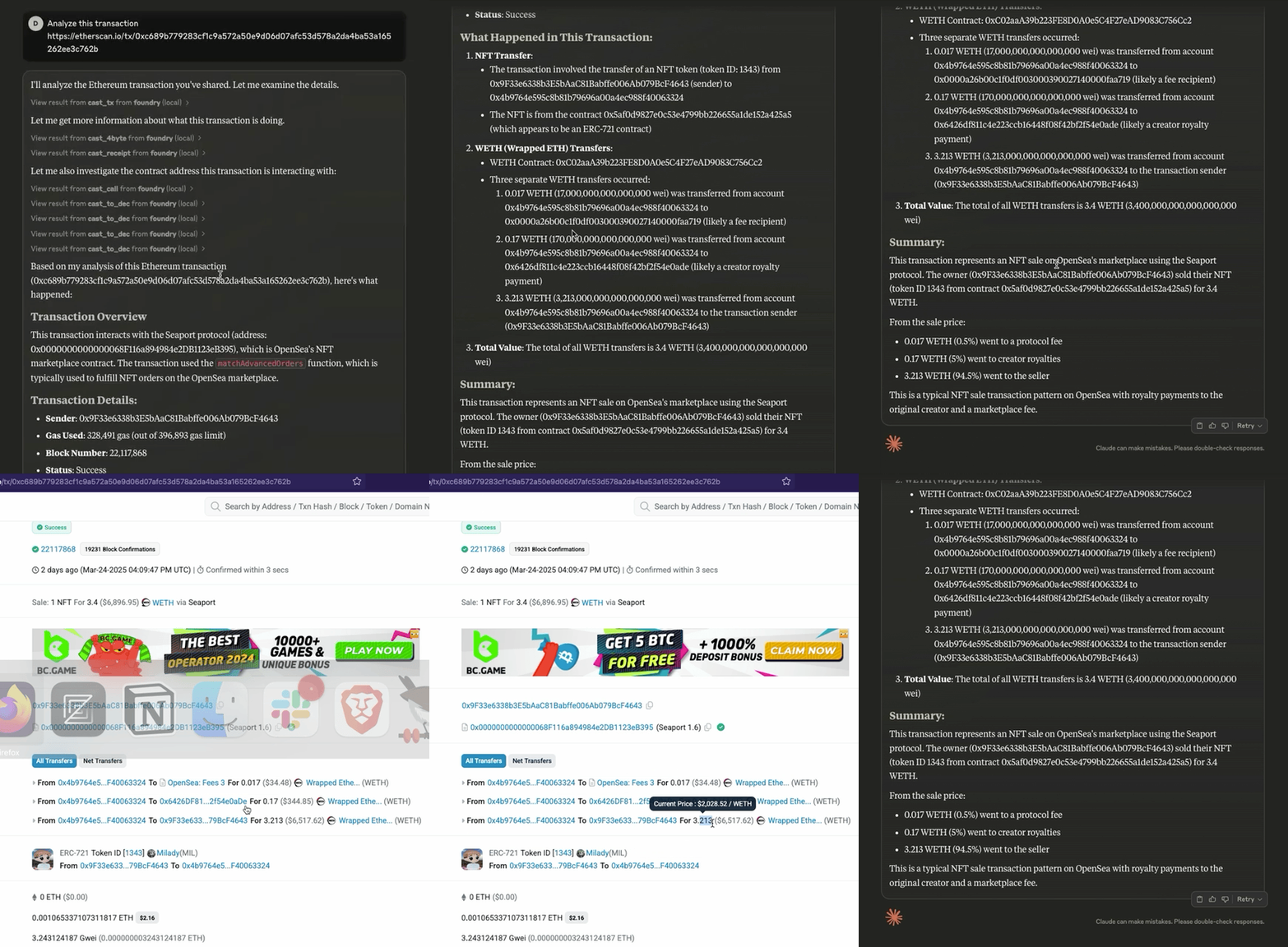
Foundry MCP Demo

Overview

This server connects LLM assistants to the Foundry ecosystem, enabling them to:

  • Interact with nodes (local Anvil instances or remote RPC endpoints)
  • Analyze smart contracts and blockchain data
  • Perform common EVM operations using Cast
  • Manage, deploy, and execute Solidity code and scripts
  • Work with a persistent Forge workspace

Features

Network Interaction

  • Start and manage local Anvil instances
  • Connect to any remote network (just specify the RPC)
  • Get network/chain information

Contract Interaction

  • Call contract functions (read-only)
  • Send transactions to contracts (if PRIVATE_KEY is configured)
  • Get transaction receipts
  • Read contract storage
  • Analyze transaction traces
  • Retrieve contract ABIs and sources from block explorers

Solidity Development

  • Maintain a dedicated Forge workspace
  • Create and edit Solidity files
  • Install dependencies
  • Run Forge scripts
  • Deploy contracts

Utility Functions

  • Calculate contract addresses
  • Check contract bytecode size
  • Estimate gas costs
  • Convert between units (hex to decimals, etc.,)
  • Generate wallets
  • Get event logs
  • Lookup function and event signatures

Smart Contract Analysis (Heimdall)

  • Disassemble EVM bytecode into human-readable opcodes
  • Decode raw calldata without requiring ABI
  • Decompile EVM bytecode to Solidity source code and ABI
  • Generate visual control flow graphs for EVM bytecode
  • Detailed transaction inspection with calldata decoding and trace analysis

Usage

The server is designed to be used as an MCP tool provider for MCP Clients. When connected to a client, it enables the clients(claude desktop, cursor, client, etc.,) to perform Solidity and onchain operations directly.

Requirements

Manual Setup

  1. Ensure Foundry tools (Forge, Cast, Anvil) are installed on your system:

    curl -L https://foundry.paradigm.xyz | bash
    foundryup
    
  2. Clone and build the server.

    bun i && bun build ./src/index.ts --outdir ./dist --target node
    
  3. Update your client config (eg: Claude desktop):

 "mcpServers": {
    "foundry": {
      "command": "node",
      "args": [
        "path/to/foundry-mcp-server/dist/index.js"
      ],
      "env" :{
        "PRIVATE_KEY": "0x1234",
      }
    }
 }

Note

PRIVATE_KEY is optional

Setup using NPM Package

You can now install and run the server directly using npm:

Global Installation
npm install -g @pranesh.asp/foundry-mcp-server
Direct Usage with npx
npx @pranesh.asp/foundry-mcp-server
MCP Client Configuration

Claude Code

 claude mcp add-json foundry-mcp-server '{"type":"stdio","command":"npx","args":["@pranesh.asp/foundry-mcp-server"],"env":{"RPC_URL":"","PRIVATE_KEY":""}}'   

Other MCP Clients (Cursor, Claude, Windsurf)

Add to your MCP settings:

{
  "mcpServers": {
    "foundry": {
      "command": "npx",
      "args": ["@pranesh.asp/foundry-mcp-server"],
      "env": {
        "RPC_URL": "http://localhost:8545",
        "PRIVATE_KEY": "0x..."
      }
    }
  }
}
Configuration

The server supports the following environment variables:

  • RPC_URL: Default RPC URL to use when none is specified (optional)
  • PRIVATE_KEY: Private key to use for transactions (optional)

Caution

Do not add keys with mainnet funds. Even though the code uses it safely, LLMs can hallicunate and send malicious transactions. Use it only for testing/development purposes. DO NOT trust the LLM!!

Tip

Getting Invalid configuration errors? Check your JSON syntax—common issues include double quotes (""KEY""KEY"), trailing commas, or unquoted keys. Validate with echo '...' | jq .

Workspace

The server maintains a persistent Forge workspace at ~/.mcp-foundry-workspace for all Solidity files, scripts, and dependencies.

Tools

Anvil

  • anvil_start: Start a new Anvil instance
  • anvil_stop: Stop a running Anvil instance
  • anvil_status: Check if Anvil is running and get its status

Cast

  • cast_call: Call a contract function (read-only)
  • cast_send: Send a transaction to a contract function
  • cast_balance: Check the ETH balance of an address
  • cast_receipt: Get the transaction receipt
  • cast_storage: Read contract storage at a specific slot
  • cast_run: Run a published transaction in a local environment
  • cast_logs: Get logs by signature or topic
  • cast_sig: Get the selector for a function or event signature
  • cast_4byte: Lookup function or event signature from the 4byte directory
  • cast_chain: Get information about the current chain

Forge

  • forge_script: Run a Forge script from the workspace
  • install_dependency: Install a dependency for the Forge workspace

File Management

  • create_solidity_file: Create or update a Solidity file in the workspace
  • read_file: Read the content of a file from the workspace
  • list_files: List files in the workspace

Utilities

  • convert_eth_units: Convert between EVM units (wei, gwei, hex)
  • compute_address: Compute the address of a contract that would be deployed
  • contract_size: Get the bytecode size of a deployed contract
  • estimate_gas: Estimate the gas cost of a transaction

Heimdall Analysis

  • heimdall_disassemble: Disassemble EVM bytecode into human-readable opcodes
  • heimdall_decode: Decode raw calldata without requiring ABI
  • heimdall_decompile: Decompile EVM bytecode to Solidity source code and ABI
  • heimdall_cfg: Generate visual control flow graph for EVM bytecode
  • heimdall_inspect: Detailed inspection of Ethereum transactions

Usage in Claude Desktop App 🎯

Once the installation is complete, and the Claude desktop app is configured, you must completely close and re-open the Claude desktop app to see the tavily-mcp server. You should see a hammer icon in the bottom left of the app, indicating available MCP tools, you can click on the hammer icon to see more details on the available tools.

Alt text

Now claude will have complete access to the foundry-mcp server. If you insert the below examples into the Claude desktop app, you should see the foundry-mcp server tools in action.

Examples

  1. Transaction analysis:
Can you analyze the transaction and explain what it does? 
https://etherscan.io/tx/0xcb73ad3116f19358e2e649d4dc801b7ae0590a47b8bb2e57a8e98b6daa5fb14b
  1. Querying Balances:
Query the mainnet ETH and USDT balances for the wallet 0x195F46025a6926968a1b3275822096eB12D97E70.
  1. Sending transactions:
Transfer 0.5 USDC to 0x195F46025a6926968a1b3275822096eB12D97E70 on Mainnet. 
  1. Deploying contracts/Running scripts:
Deploy a mock ERC20 contract to a local anvil instance and name it "Fire Coin".

Acknowledgments ✨

Disclaimer

The software is being provided as is. No guarantee, representation or warranty is being made, express or implied, as to the safety or correctness of the software. They have not been audited and as such there can be no assurance they will work as intended, and users may experience delays, failures, errors, omissions, loss of transmitted information or loss of funds. The creators are not liable for any of the foregoing. Users should proceed with caution and use at their own risk.

foundry-mcp-server FAQ

Is this ready for serious use?
The author labels it experimental and the last commit was January 2026. Treat it as a testing helper, not something to trust with real funds.
Do I need a key?
Not for reading. A wallet key is optional and only needed to send transactions, and the author warns against using one that holds real money.
Can I use this to work out what a transaction did?
Yes. Hand it a transaction link and it can fetch the receipt, decode the call and walk through the trace.
How hard is setup?
Developer level. The Foundry command-line tools must already be installed, and Node.js 18 or newer is required.
Do the decompiling and flow-chart features work straight away?
No. Those five options call Heimdall, a separate program you install yourself. Without it they simply fail.
Which apps does it work in?
Claude Desktop, Cursor, Windsurf and Claude Code are all documented, each using a short config snippet.
Is this useful if I do not write code?
Mostly no. It assumes Solidity and Ethereum knowledge, though the transaction explanations are readable by anyone curious about a payment.