


This document details the architectural workflow of an AI-powered code generation system. The system follows a structured process where user requests are analyzed, necessary modules are identified, and code is generated in a modular, human-in-the-loop (HITL) approach. This ensures that the user has control over the process and can intervene when necessary.
The workflow consists of multiple interconnected nodes that perform specific tasks. Below is a breakdown of each node and its function:
- This node serves as the initial entry point for user requests.
- It performs natural language processing (NLP) to understand user input.
- It engages in small talk to improve user experience and asks for any missing information.
- Once the request is fully understood, it moves to the next step.
- The system analyzes the user’s request and extracts the necessary modules required for code generation.
- The identified modules are presented to the user for selection.
- This step follows the HITL approach, allowing the user to manually confirm or modify module selection before proceeding.
- For each selected module, the system generates a set of steps required to create the code.
- It processes modules in a sequential order, starting with the first one in the checklist.
- The generated steps are then sent for code execution.
- Based on the chosen framework (e.g., Python, Java, Node.js, etc.), the system routes the module to the appropriate MCP (Model Context Protocol) server.
- The MCP server ensures that the module is processed correctly according to the predefined framework.
- The MCP server processes the module and generates a fully functional code snippet.
- The system ensures that the generated code adheres to best practices and predefined architecture standards.
- After code generation, the system creates a Docker container.
- The code is built, compiled, and executed within the containerized environment.
- This step ensures portability and consistency across different development environments.
- If there are errors or execution failures, the system attempts to fix the issues automatically.
- It retries the code generation and execution process up to five times before escalating the issue.
- If the error persists, the process moves to the HITL intervention step.
- If errors persist after multiple retries, the user is asked to intervene.
- The system presents the user with two options:
- React to the error (modify request, debug, etc.).
- Continue to the next module despite the error.
- If the user chooses to continue, the system marks the current module as complete and moves to the next one.
- This loop continues until all modules are successfully generated and executed.
The following diagram illustrates the entire workflow:
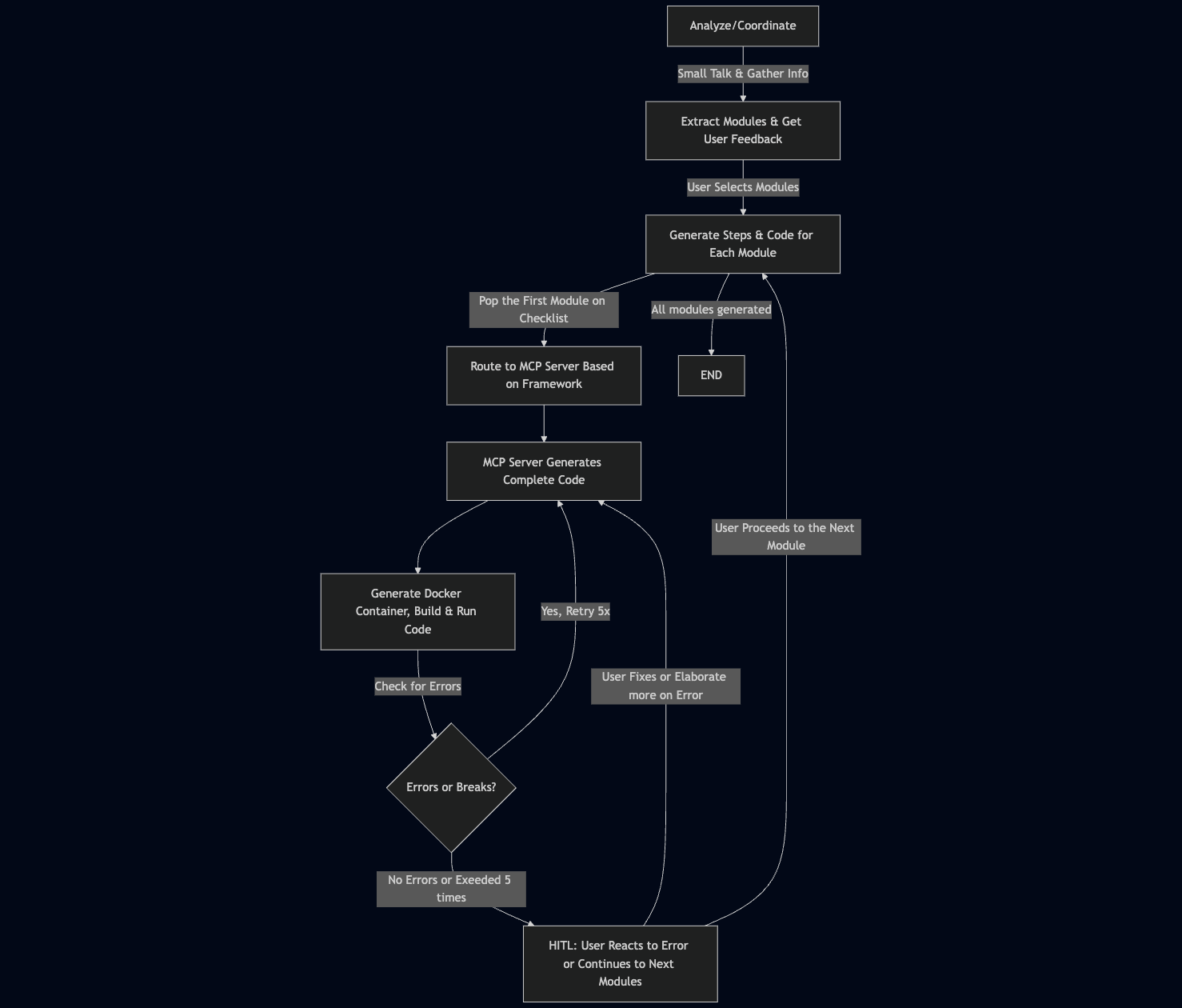
This architecture follows a structured approach to AI-driven code generation with built-in human oversight (HITL). It allows for efficient, modular code generation while maintaining flexibility and user control. The error handling and retry mechanism ensure robustness, while Docker-based execution guarantees environment consistency. This system can be further enhanced by integrating AI-powered debugging and automated testing.
Let me know if you need any refinements or additional details! 🚀