



A MCP server to allow the LLM in Cursor to access Rust Analyzer, Crate Docs and Cargo Commands.
Includes an UI for configuration.
Currently, various AI agents don't offer the AI the ability to access Rust type information from the LSP. This is a hurdle because instead of seeing the type, the LLM has to reason about the potential type.
In addition, the only information about the dependencies (say tokio) are what they were trained on which is
out of date and potentially for a different version. This can lead to all kinds of issues.
Cursor Rust Tools makes these available over the Model Context Protocol (MCP).
- Get the documentation for a
crateor for a specific symbol in thecrate(e.g.tokioortokio::spawn) - Get the hover information (type, description) for a specific symbol in a file
- Get a list of all the references for a specific symbol in a file
- Get the implementation of a symbol in a file (retrieves the whole file that contains the implementation)
- Find a type just by name in a file the project and return the hover information
- Get the output of
cargo test - Get the output of
cargo check
For the LSP functionality src/lsp it spins up a new Rust Analyzer that indexes your codebase just like the on running in your editor. We can't query the one running in the editor because Rust Analyzer is bound to be used by a single consumer (e.g. the open document action requires a close document in the right order, etc)
For documentation, it will run cargo docs and then parse the html documentation into markdown locally.
This information is stored in the project root in the .docs-cache folder.
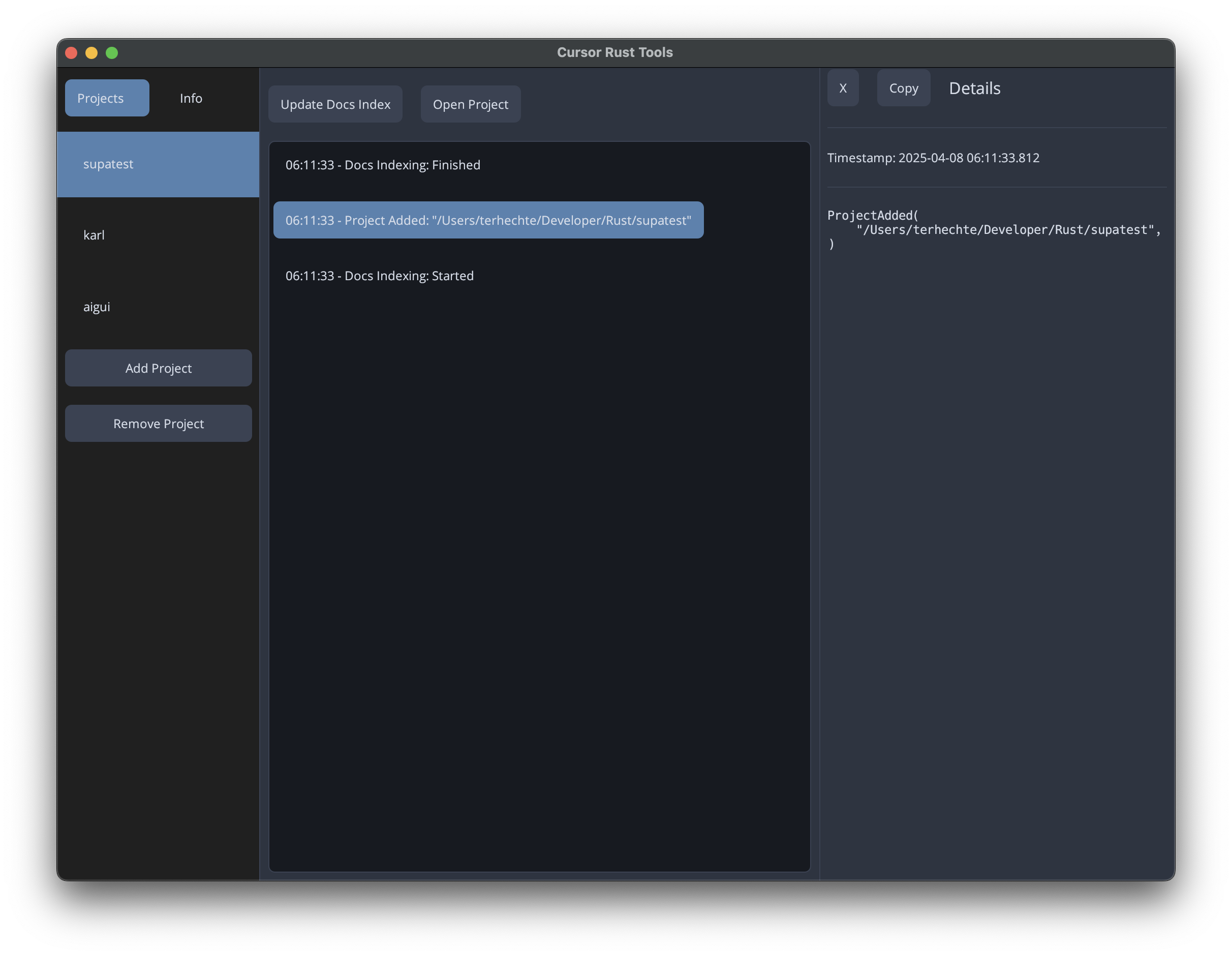
cargo install --git https://github.com/terhechte/cursor-rust-toolscursor-rust-toolsThis will bring up a UI in which you can add projects, install the mcp.json and see the activity.
Alternatively, once you have a ~/.cursor-rust-tools set up with projects, you can also just run it via
cursor-rust-tools --no-uiIn stead of using the UI to create a configuration, you can also set up ~/.cursor-rust-tools yourself:
[[projects]]
root = "/Users/terhechte/Developer/Rust/example1"
ignore_crates = []

[[projects]]
root = "/Users/terhechte/Developer/Rust/example2"
ignore_crates = []
ignore_crates is a list of crate dependency names that you don't want to be indexed for documentation. For example because they're too big.
One the app is running, you can configure Cursor to use it. This requires multiple steps.
- Add a
project-dir/.cursor/mcp.jsonto your project. TheCursor Rust ToolsUI has a button to do that for you. Running it without UI will also show you themcp.jsoncontents in the terminal. - As soon as you save that file, Cursor will detect that a new MCP server has been added and ask you to enable it. (in a dialog in the bottom right).
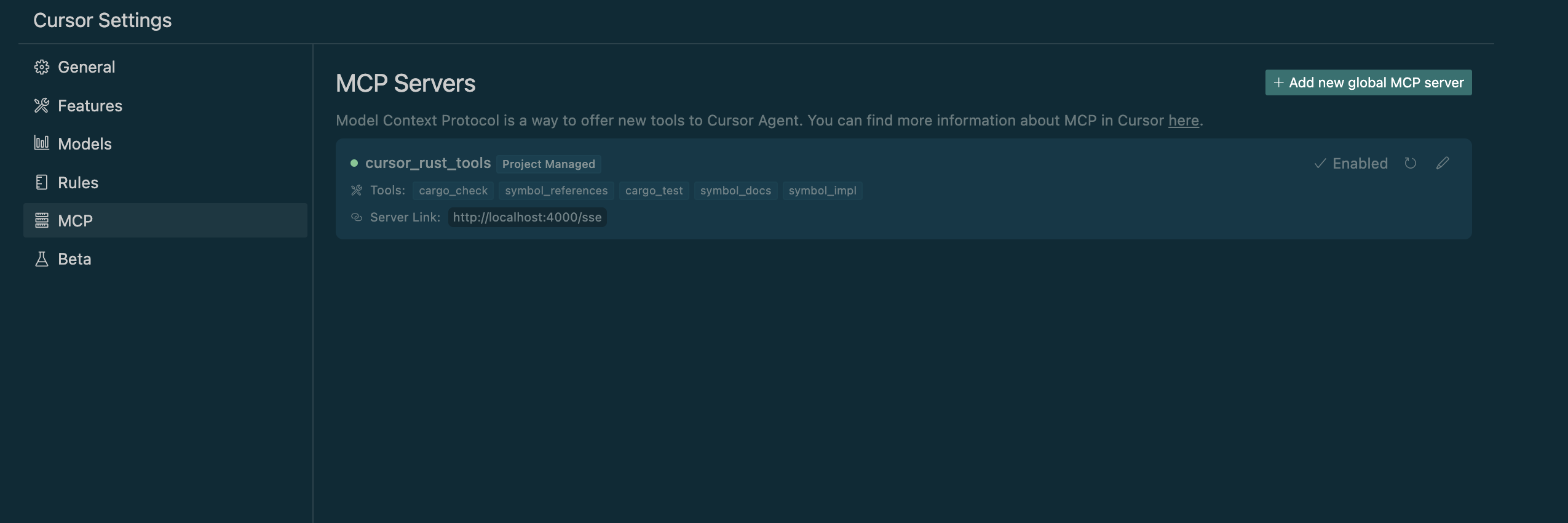
- You can check the Cursor settings (under
MCP) to see where it is working correctly - To test, make sure you have
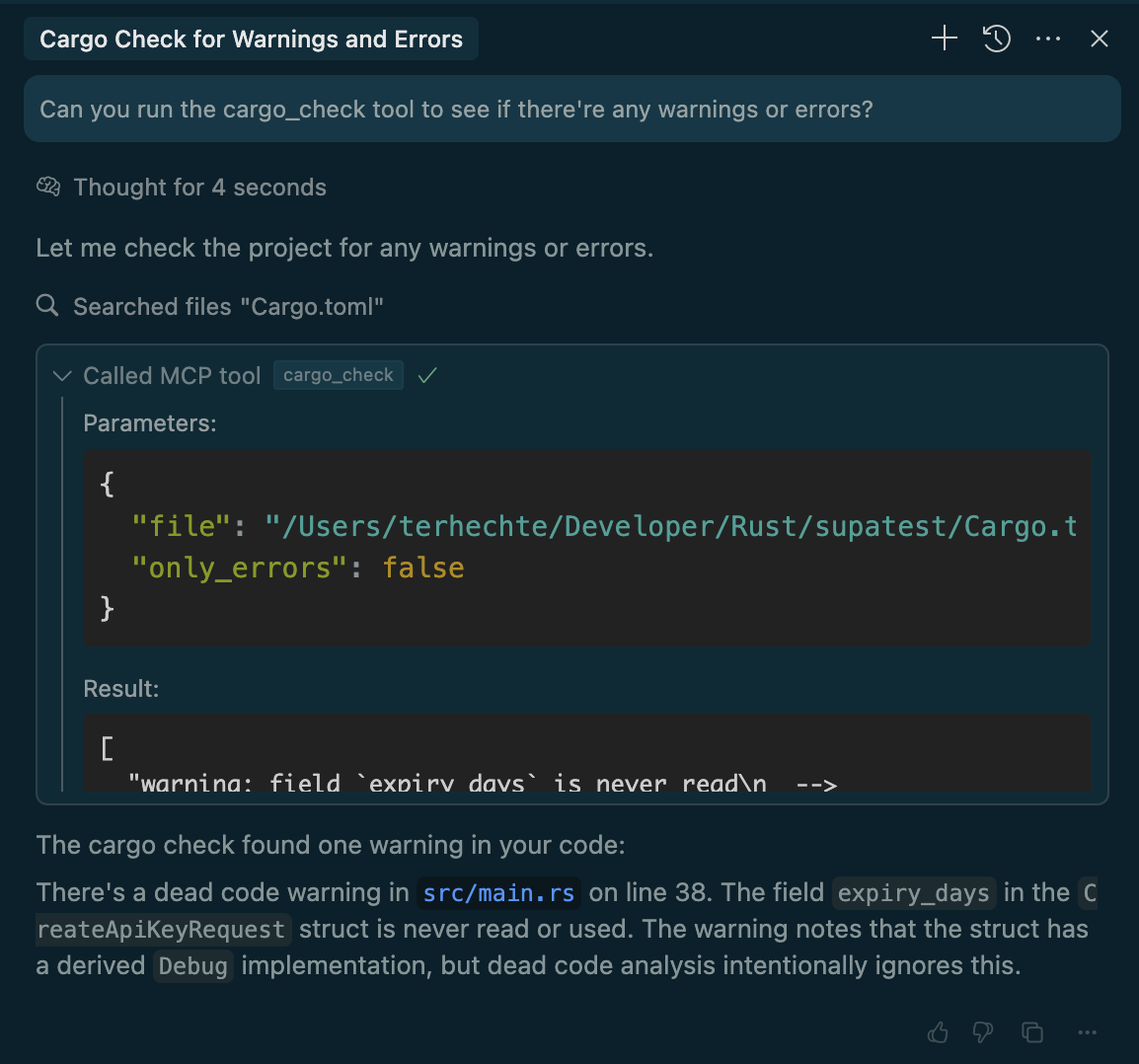
Agent Modeselected in the currentChat. And then you can ask it to utilize one of the new tools, for example thecargo_checktool. - You might want to add cursor rules to tell the LLM to prefer using these tools whenever possible. I'm still experimenting with this.
The contents of all the mcp.json is the same. Cursor Rust Tools figures out the correct project via
the filepath
- Create a Zed extension to allow using this
- Proper shutdown without errors
- Removing a project is a bit frail right now (in the UI)
- Expose more LSP commands
- Allow the LLM to perform Grit operations