
clarilayer

clarilayer

MCP.Pizza Chef: clarilayer

Every new chat, an assistant forgets how your team defines revenue, which table is the right one, and the correction you made last week. ClariLayer stores those facts once and hands them back at the start of each session, along with where each one came from. It can also compare a saved definition against real results and flag it when the two disagree. Free for individuals, it works in Claude Code, Cursor, Codex, and claude.ai.

Coding
Data

Use This MCP server To

Save how we define revenue so nobody re-explains it Correct my assistant once and have the fix stick Check a saved definition against what the numbers actually say Import definitions I already wrote down somewhere else Carry the same context between Claude Code and Cursor See where a saved fact came from before trusting it

README

MseeP.ai Security Assessment Badge

ClariLayer

ClariLayer

Stop re-explaining your data to your AI every session.

The individual-analyst context layer, delivered over MCP.
Connect it to Claude Code, Cursor, Codex, or claude.ai — your agent stops making the same data mistakes.

Website · Docs · Get started (free) · Use cases

MCP server Clients Free for individuals


ClariLayer is an individual-analyst context layer, delivered over MCP. Connect it to Claude Code, Cursor, Codex, or claude.ai and it bootstraps your real working context from the SQL and dbt you already have, reconciles your definitions against your warehouse, and remembers your corrections — so your agent stops re-explaining your data and stops making the same mistakes every session.
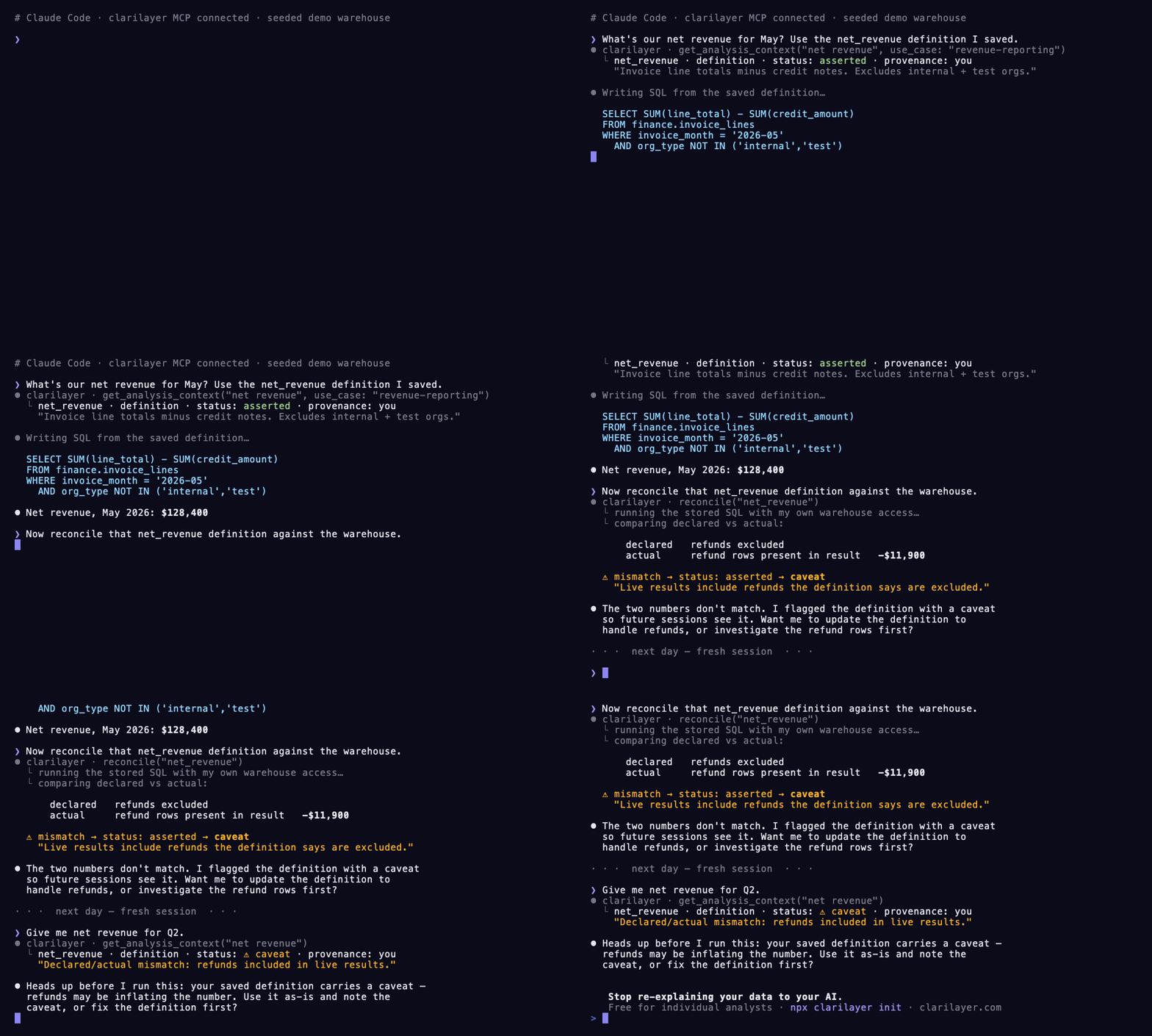
ClariLayer in Claude Code: the agent recalls a saved net-revenue definition, reconciles it against the warehouse, finds refunds the definition excludes, and flags the entry with a caveat that's waiting in the next session

A seeded demo warehouse: your agent recalls a saved definition, reconciles it against real results, and the mismatch is flagged as a caveat that's waiting next session. Statuses are asserted / caveat — never "verified".

The problem

Every new session, your AI coding agent starts from zero about your data. So it makes the same mistakes — queries the wrong table, picks the wrong join, counts refunds in revenue, uses a churn definition you deprecated months ago. You correct it. Next session, it forgets, and you correct it again.

A hand-written CLAUDE.md of definitions helps a little — but it has the same trust problem as the original numbers: it's just asserted text. Nobody checked it against your warehouse.

clarilayer FAQ

Which apps does this work in?
Claude Code, Cursor, Codex, and claude.ai — anything that can connect to a hosted MCP address.
Do I have to pay?
It is free for individuals. You sign up and create a free context key, except on claude.ai, which signs you in directly instead.
Can I use this to stop correcting the same mistake every session?
Yes — that is the point. A correction you save once gets pulled back automatically the next time the topic comes up.
How hard is setup?
One command sets it up and detects your apps, or you paste a short snippet with your key. On claude.ai you paste a web address and sign in.
Does it read my database itself?
No. Your assistant runs the query with its own access and reports the result back, so ClariLayer never needs your database credentials.
What happens when a saved definition turns out to be wrong?
The mismatch is recorded as a caveat attached to that definition, and it is waiting for you at the start of the next session.