


The largest and fastest-growing open-source project for AI context, data cataloging, and metadata management.
OpenMetadata is the open platform for trusted data context, organizational memory, and business semantics for every data user, AI assistant, and agent.
OpenMetadata connects technical metadata, data quality signals, lineage, column-level lineage, ownership, usage, policies, conversations, memories, glossaries, classifications, metrics, domains, data contracts, and data products into a unified metadata knowledge graph. With 130+ connectors, open metadata standards, semantic search, APIs, SDKs, and an MCP server, OpenMetadata gives every user and AI system the governed context it needs to discover, understand, trust, remember, and use data.
AI does not need another raw database connector. AI needs context + memory.
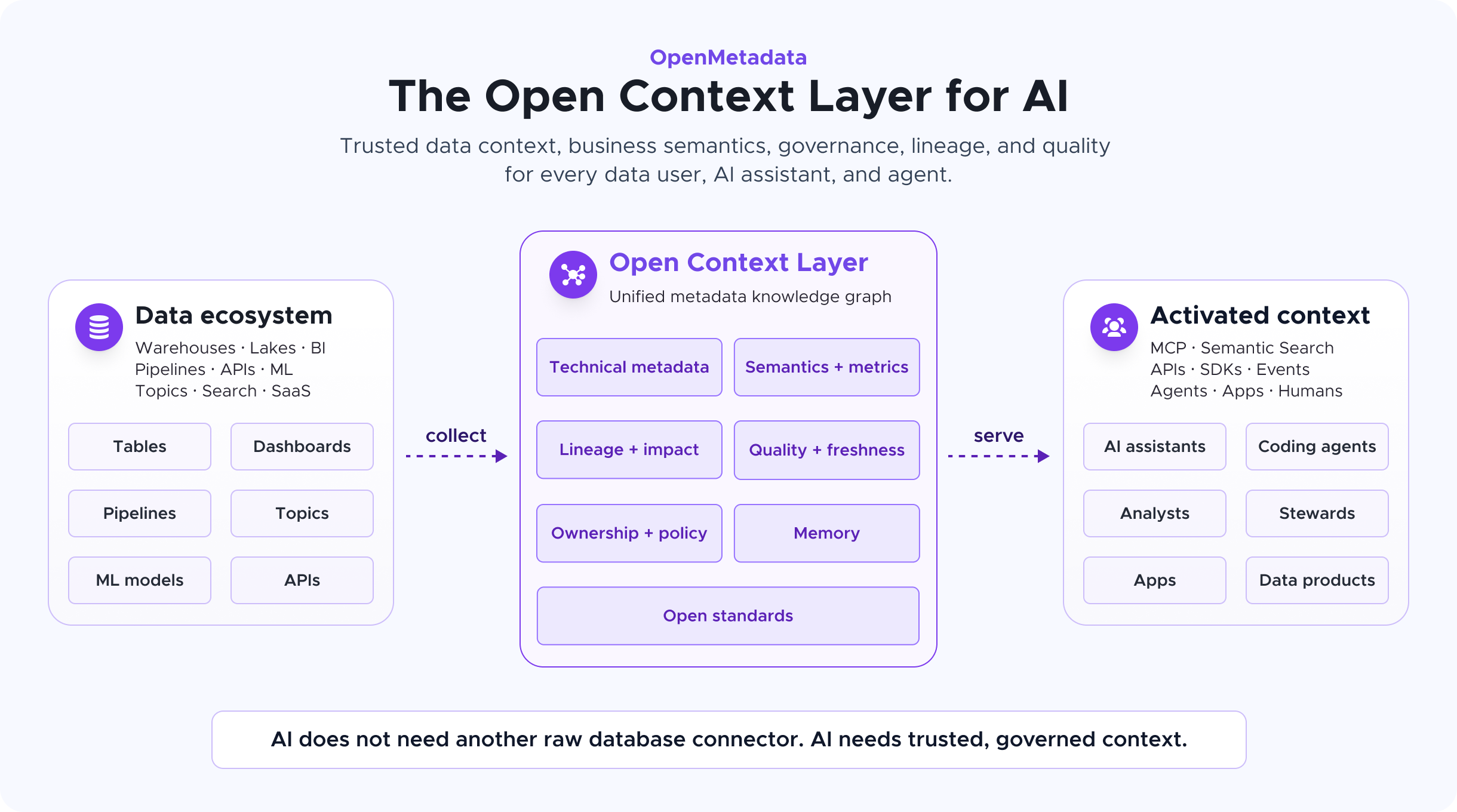
OpenMetadata provides the context AI needs to know:
- what data exists
- what it means
- who owns it
- how it is used
- where it came from
- where it flows
- whether it is fresh, tested, certified, and trusted
- which business concepts, classifications, glossary terms, policies, contracts, and data products apply
- what downstream dashboards, pipelines, metrics, ML models, and applications depend on it
- what conversations, decisions, assumptions, and memory nuggets have already been captured about it
AI systems need more than data access. They need governed context, business meaning, trust signals, lineage, usage, ownership, standards, and organizational memory.
A direct connection to a warehouse, lake, dashboard, or pipeline exposes raw structures. It does not tell an AI assistant what the data means, whether it is certified, who owns it, which policies apply, what contract governs it, what breaks if it changes, or what the organization has already learned about it.
OpenMetadata is the open context layer that gives every data user and AI agent the full picture of enterprise data.
OpenMetadata brings together five capabilities:
- Context — technical, operational, trust, usage, and lineage metadata from across the data ecosystem.
- Semantics — business meaning through glossaries, metrics, classifications, domains, policies, ontologies, and data products.
- Knowledge Graph — relationships connecting assets, columns, people, teams, quality, lineage, policies, memories, contracts, and business concepts.
- Memory — conversations, AI threads, decisions, assumptions, runbooks, remediation notes, and reusable memory nuggets that preserve tribal knowledge.
- Activation — MCP, Semantic Search, APIs, SDKs, events, and workflows that make context usable by AI assistants, agents, applications, and humans.
With OpenMetadata, users and AI agents can answer: