
pituitary

MCP.Pizza Chef: nantobv

Pituitary helps you keep your project documentation, specifications, and code aligned by finding contradictions, overlaps, and outdated information before they cause problems. It works locally with apps like Cursor, Cline, and Windsurf, requiring no API keys but some developer setup. You can scan your entire project to catch stale docs, check code changes against specs, and maintain a single source of truth for your team’s governance.

Coding
Other

Use This MCP server To

Detect contradictions between code and project specifications Find and fix stale or outdated documentation Identify overlapping or conflicting decisions in specs Check code changes for compliance before merging Trace the impact of spec changes across documents Generate reports on documentation and spec health Search specs by topic or relevance

README

Peet the Pituitary mascot

Pituitary

Consistency governance for AI-native development.

Catch drifts before they catch you.

CI Go Report Card Release License

What It Catches · Quick Start · Agent · CI · Cheatsheet · Reference


For developers and teams where human+AI continuously produce specs, docs, and decisions that should agree — and silently stop agreeing.
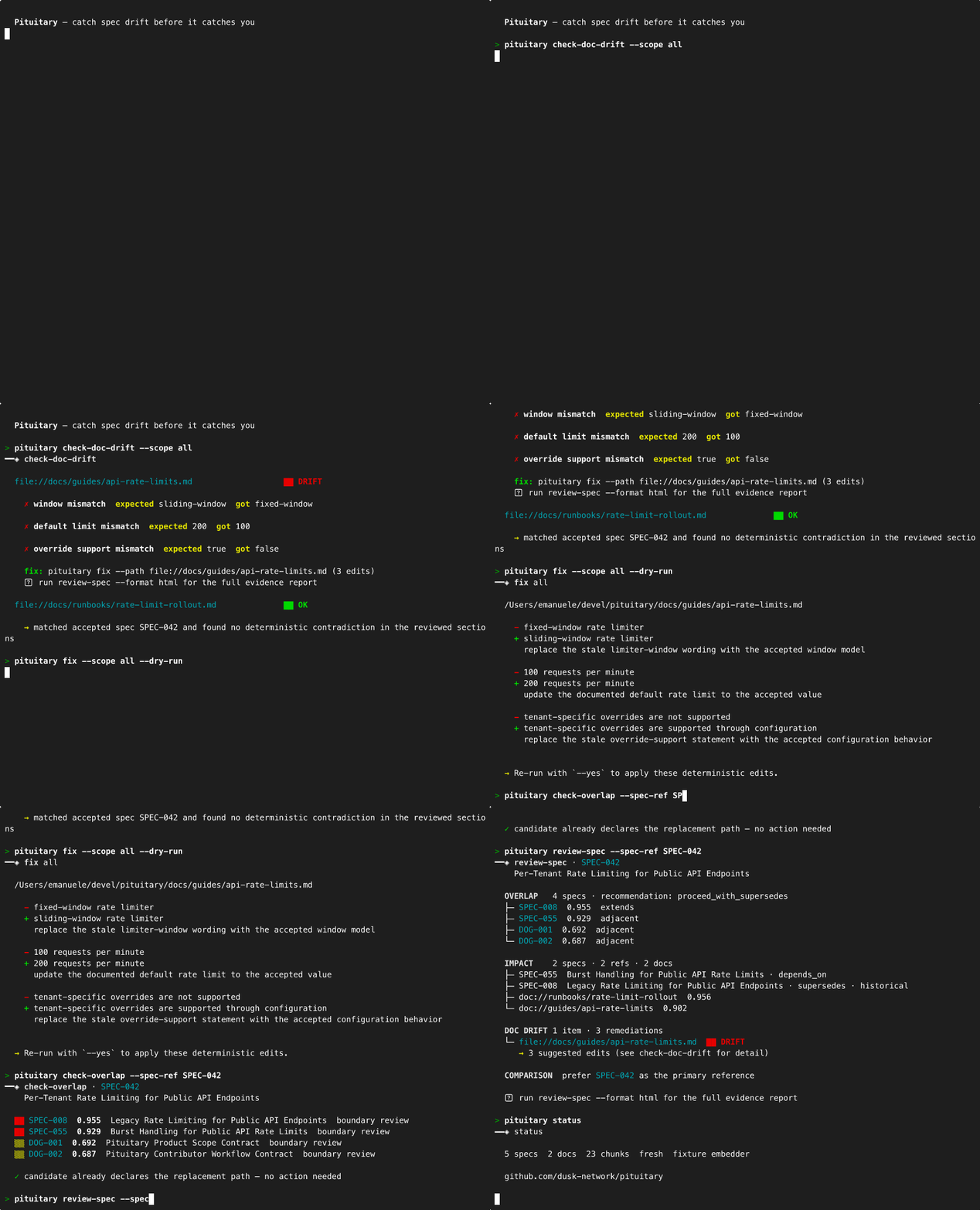
demo

Watch on asciinema for the interactive version.

Single binary. No Docker. No API keys required. One governance SQLite file plus one local Stroma snapshot.

The core shipped slice is local and CLI-first. The MCP server, CI wiring, and provider-backed semantic runtimes are optional wrappers around that same deterministic core.

What It Catches

You already know your docs drift. You fight it with LLM cleanup passes. The LLM says "all clean" — but it only covered what fit in the context window. The rest keeps rotting. Next PR introduces fresh contradictions on top of the ones that were never actually fixed. It's a treadmill that feels productive but never converges. Meanwhile the token costs pile up: false starts, misdirections, and wasted context directly caused by drifting issues, conflicting specs, and obsolete docs.

Pituitary replaces that treadmill with a structural guarantee: it indexes the entire corpus and checks all of it, every time. On a real repo with 11 specs and 29 docs, it found 90 deprecated-term violations across 22 artifacts and 7 semantic contradictions. The project direction was plagued by doc drifts, runtime contract contradictions, and deprecated terminology surfacing everywhere — Pituitary rescued it. Across multiple repos, it becomes the single point of truth where governance converges.

Overlapping decisions. A new spec covers ground an existing one already handles.

Stale docs. A spec changed, or a code diff implies docs likely went stale, but the CLAUDE.md, AGENTS.md, runbooks, and guides that reference it weren't updated.

Code that contradicts specs. Pipe your diff in before you merge:

git diff origin/main...HEAD | pituitary check-compliance --diff-file -

Terminology drift. The team adopted new language but old terms persist across your docs and specs.

pituitary FAQ

Can I use this to find contradictions between my project specs and code?
Yes — Pituitary indexes your specs, docs, and code diffs to detect conflicts and outdated information.
Can I use this to detect stale documentation automatically?
Yes — it scans your entire documentation and flags parts that are outdated or inconsistent with current specs.
Which apps support Pituitary?
It works with Cursor, Cline, and Windsurf apps that support MCP servers.
Do I need an API key or account to use Pituitary?
No — it runs locally without requiring API keys or accounts.
How difficult is it to set up Pituitary?
It requires developer-level setup, including installing and running the binary from source or releases.
Can Pituitary check my code changes before merging?
Yes — you can pipe your git diffs to Pituitary to check compliance with specs before merging.
Does Pituitary handle multiple repositories?
Yes — one config file can span multiple repo roots for governance across projects.