
Cross-cloud GPU infrastructure CLI for training, inference, and AI workload orchestration with agent sandbox, mesh, and MCP subcommands.
License: Apache 2.0 - Free and open source for commercial and personal use.
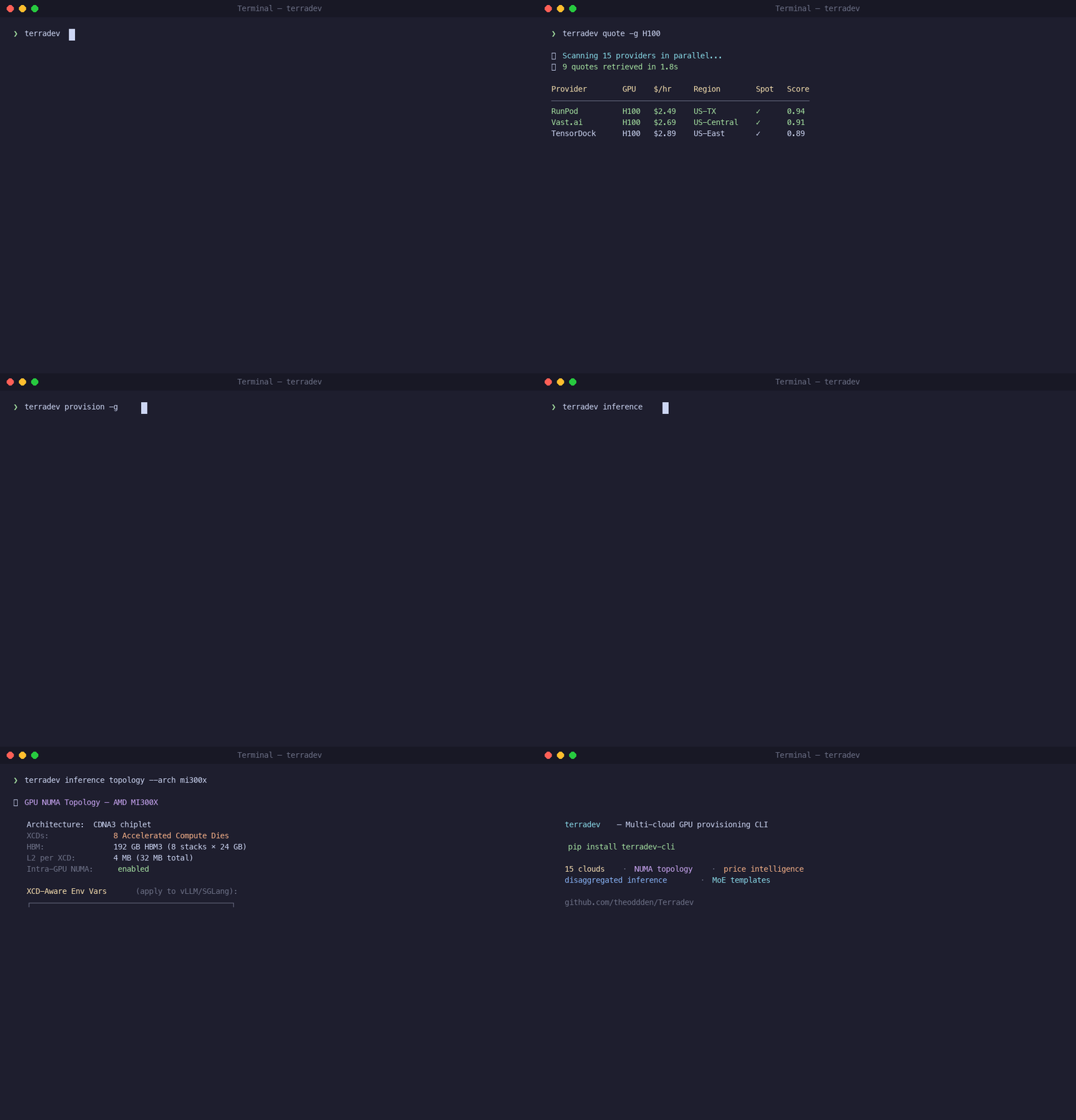
Terradev is a cross-cloud compute control plane for AI workloads, not just a provisioning wrapper.
Combines quoting, provisioning, topology optimization, training orchestration, inference tuning, and cost analytics in one CLI, with a Rust-accelerated idempotent runtime underneath.
Continued focus on lower cost, faster provisioning, and topology-aware execution with local credential storage.
Model agnostic. Dataset agnostic. GPU agnostic. Provider agnostic. The only thing Terradev is not agnostic about is correctness: it enforces topology, idempotency, and sequencing.
NOTES ON 6.0.8
- New agent subcommands —
terradev agent sandbox,terradev agent mesh, andterradev agent mcpare now real, dependency-resolving commands instead of placeholders:terradev agent sandboxruns untrusted payloads with hardware-isolated runtimes (bwrap,runsc,firecracker, and Linux Landlock LSM), all discoverable/downloadable viaDependencyManager.terradev agent meshcreates a decentralized peer-to-peer agent mesh using reallibp2p(go-libp2p-daemon+p2pclient), A2A HTTP, andWireGuardencrypted transports.terradev agent mcpis a dynamic Model Context Protocol bridge with stdio and HTTP transports and a multi-server bridge.
NOTES ON 6.0.0
-
Unsloth (
terradev train unsloth): optimized local LLM training, serving, and coding agents with 70% lower VRAM usage and faster training via Triton kernels. Subcommands:run,start,stop.terradev train unsloth run --model unsloth/Llama-3.1-8Bterradev train unsloth run --model unsloth/Qwen3.6-7B-GGUF:Q4_K_M --port 8080terradev train unsloth start claude --model unsloth/Llama-3.1-8Bterradev train unsloth stop
-
Weaviate (
terradev database weaviate): vector database operations with local, embedded, cloud, and custom environments. Subcommands:up,list-collections,create-collection,delete-collection,insert,query,hybrid-search.terradev database weaviate up --environment localterradev database weaviate create-collection --name Article --vector-size 384terradev database weaviate insert --collection Article --objects '[{"properties": {"title": "Hello"}, "vector": [0.1, ...]}]'terradev database weaviate query --collection Article --vector '[0.1, ...]' --top-k 5terradev database weaviate hybrid-search --collection Article --query "generative AI" --top-k 5
-
Letta (
terradev agent letta): stateful agents with long-horizon memory across sessions. Subcommands:create,list,chat,status,delete,remember.terradev agent letta create --name my-agent --model openai/gpt-4.1terradev agent letta listterradev agent letta chat --agent-id <id> --message "hello"terradev agent letta remember --agent-id <id> --text "Our staging cluster is on us-east-1" --label factterradev agent letta status --agent-id <id>terradev agent letta delete --agent-id <id>
-
Removed integrations:
terradev ml databricksandterradev ml langsmithcommand groups, all related MCP tools, and Jaeger tracing endpoints in the Helm values have been removed. -
Version bumped to 6.0.0 to reflect these breaking changes.
NOTES ON 5.7.10
- Local Ollama integration (
terradev ml ollama): list, pull, generate, chat, inspect, and check running models on a local Ollama server (list,pull,generate,chat,info,ps). - DeepEval integration (
terradev ml deepeval): install, run test suites, list metrics, and evaluate single LLM outputs with metrics likeAnswerRelevancyMetric,FaithfulnessMetric, andHallucinationMetric(install,init,run,metrics,evaluate). - MCP tool surface now at 237 tools, including
ollama_*anddeepeval_*tool definitions and handlers.
NOTES ON 5.7.7