

Not a path. Not a URL. A handoff that answers back.
Locations are dumb — no per-agent shaping, no receipts, no way to fix them once sent. waggle's 30-byte token resolves into each agent's own view, counts every read, and propagates a correction to every holder. A path can't do that; a URL needs a server; this needs neither.
The problem ·
How it works ·
Install ·
Harness setup ·
By file type ·
Reach ·
Switchboard ·
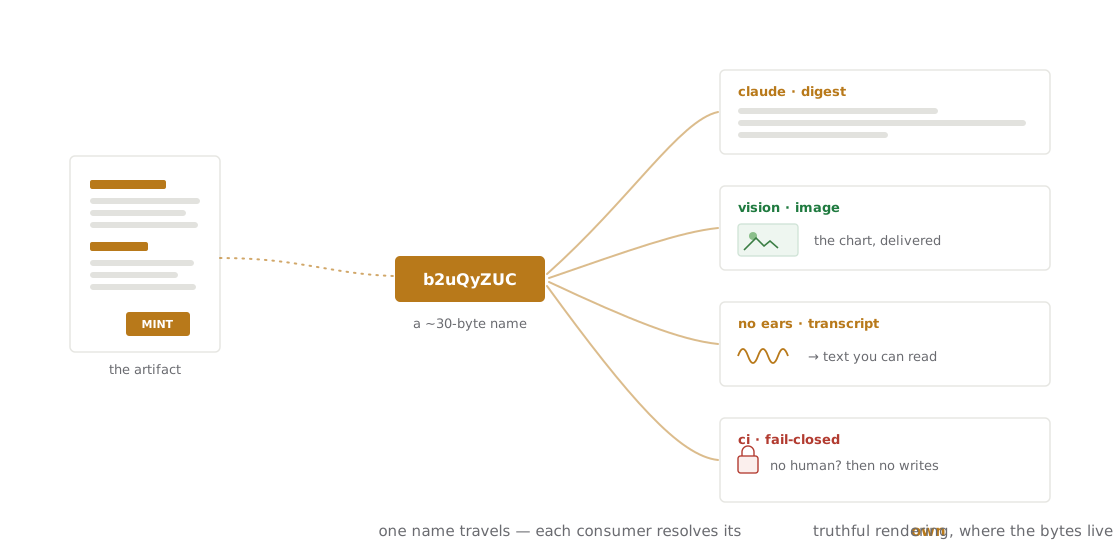
We are entering the world of agent harnesses: Claude Code orchestrators fanning out subagents, Codex sessions delegating in parallel, cross-vendor agents discovering each other over open protocols. And every one of these handoffs, today, works the same way: forward the context and hope.
The costs are measured, not hypothetical. Multi-agent systems consume ~15× the tokens of a chat session — the overhead attributed by the vendor itself to "duplicating context across agents… and summarizing results for handoffs," whose one-line summary is "each handoff loses context." Roughly 37% of multi-agent failures trace to exactly this seam.
Waggle's competitor is not another protocol. It is
"Here's /tmp/analysis.md. Use it." — and that instinct is correct: a
path is a 30-byte reference, which is exactly the right size for a handoff.
But a raw path has no attribution (who made this, from what), no
adaptation (the small-context model gets the same 9,000 tokens as the
frontier model), no lifecycle (a stale path silently serves wrong data
forever), no telemetry (which subagent actually read its input? which
stalled?), and no reach (it dies at the machine boundary).
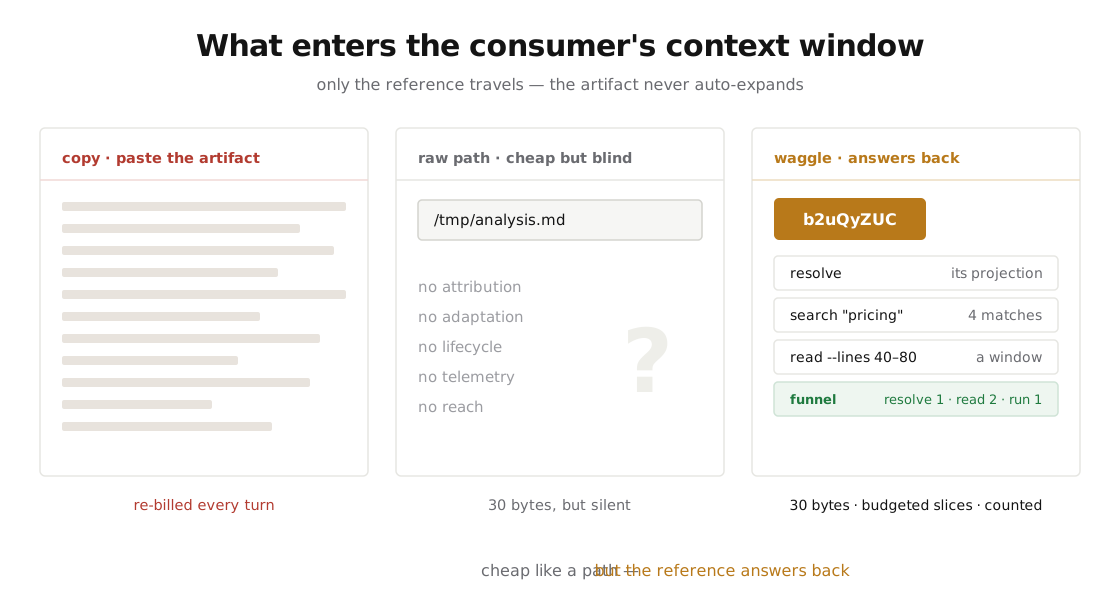
Only the string enters the consumer's context — the artifact behind it
never travels unless something fetches it. Waggle standardizes that third
pattern and enforces its one hard rule by type: the token travels; the
artifact never auto-expands; resolve, read, and search return only the
projection or slice the consumer asked for, under byte budgets. Cheap like a
path — but the reference answers back.