
Web search for LLM agents that you run yourself - up to 8x fewer input tokens and 3x lower cost than hosted web_search, at the same accuracy.
Hosted web-search tools charge $10 per thousand searches and then bill you
again for every token of retrieved content they push into your context
window. webfetch replaces them with a local pipeline - multi-engine
search, page fetching and extraction, semantic reranking, sentence-level
compression - exposed as a web_search tool your model calls like any
other. And unlike every hosted tool and search API we surveyed, repeated
and paraphrased queries are served from a semantic cache for free.
(Install with pip install webfetch-llm; the import name is webfetch.)
Jump to: The headline · What you get · Getting started · Check your setup · Full benchmark results · Claude Code · Agent loop · Savings report · How it works · Caveats
One agent loop, one model, one judge, 50 SimpleQA questions. The only thing that changes between rows is the search tool:
| search tool | accuracy | input tok/query | cost/query |
|---|---|---|---|
| Anthropic hosted web_search | 96% | 17,408 | $0.108 |
| webfetch (4-engine fusion) | 92% | 3,467 | $0.035 |
| webfetch (DDG only, $0 in fees) | 84% | 3,623 | $0.026 |
Swap Opus for gpt-5.6-sol and the same webfetch tool hits 96% - hosted parity - at $0.040/query and 2,156 tokens: an eighth of what the hosted tool pushes into your context. Full results cover every arm we ran.
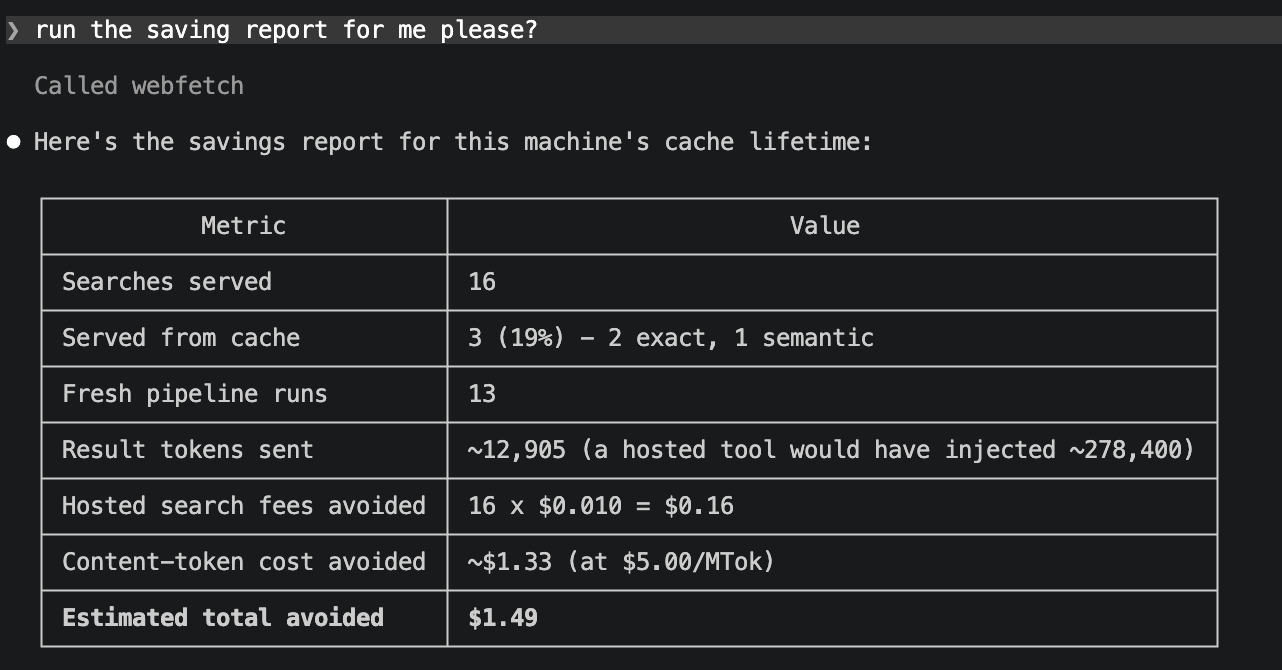
These numbers are the WORST case for webfetch - measured on an empty cache. In real use the gap widens on its own: repeats and rewords serve from cache for free, and the token advantage is paid again on every later turn that keeps search results in context. It adds up to receipts like this one, from an ordinary Claude Code session:
Every claim in this README is generated by an eval harness that ships in
this repo - the question sets, per-question records, judging protocol,
and the negative results are all in
A search pipeline you own (4-engine RRF fusion, local extraction, sentence-level compression). Results come from reciprocal-rank fusion across DuckDuckGo, Brave, Serper, and Tavily - whichever of them you have keys for. DDG needs no key, so the tool works at literally zero cost out of the box; every key you add joins the fusion automatically. Pages are fetched and extracted locally (trafilatura, readability, newspaper4k, Playwright rendering for JS pages and 403 walls), chunked, ranked by a hybrid BM25 + bi-encoder cascade with a cross-encoder on top, then compressed to the sentences that answer the query - measured 50% fewer tokens at zero recall loss.
Caching nobody else has (exact + semantic matching, volatility-aware
TTLs). Two layers in one sqlite file: page text by
URL, ranked results by query. Identical queries hit an exact cache.
Paraphrased queries hit a semantic cache - an embedding shortlist
verified by an NLI cross-encoder, tuned eval-first for precision (zero
wrong-target matches across every live run we have done). Cache lifetimes
adapt to the query: prices and scores expire in 15 minutes, current-ish
topics in 7 days, release notes and specs in 90 - classified by the
calling model's hint or a local classifier. The model sees provenance on
every cached result ([cache: semantic match to "...", 2h old, recent])
and can send force_fresh when it disagrees. No hosted tool or search
API we surveyed offers any client-visible caching at all.